
For street food & mobile catering
Mobile catering van leasing
Yes, limited companies and LLPs lease a base vehicle for mobile catering from FleetMe on business contract hire. The conversion is a change to a vehicle we own, so it is agreed in writing first. Sole traders hire short-term.
Check my options →Updated 15 October 2026 · your agreement is with FleetMe
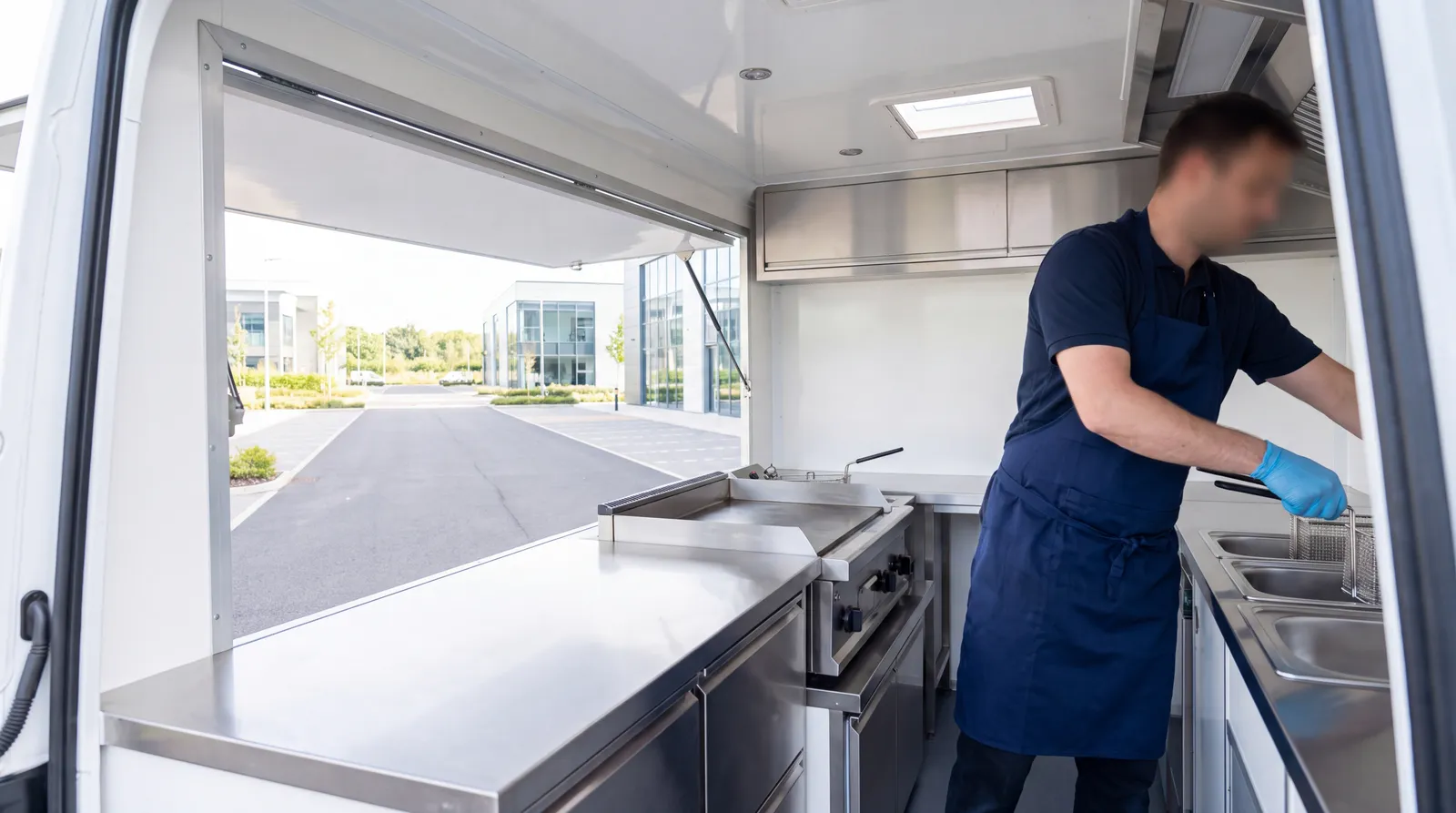
A catering conversion turns a van into premises, and that changes the leasing conversation. The fit-out is heavy, it needs power and often gas, it has to satisfy a local authority, and it is a permanent alteration to an asset that is not yours. None of that is a problem. It just has to be agreed up front rather than discovered halfway through a build.
How much does a catering fit-out weigh?
Catering equipment is dense and water is the quiet killer: fresh and waste water weigh a kilogram per litre, so a 100-litre fresh tank plus a waste tank is well over 150kg of payload before you count a griddle, a fryer, gas bottles, a generator, refrigeration, stock and two staff. All of it comes out of the vehicle's payload, its gross weight limit minus what the converted vehicle already weighs. A car licence obtained from 1 January 1997 caps you at 3,500kg maximum authorised mass (DVLA), so a large-panel or Luton base is often the honest starting point rather than the medium van the budget suggested.
Do you need consent to convert a leased van?
The vehicle stays our asset for the life of the contract, so a catering fit-out, gas, electrics, serving hatch, flooring, needs our written agreement before it is installed. That is a straightforward conversation if it happens at quote stage, and it lets us set out clearly what the contract expects at the end of the term, including whether equipment is removed and how the vehicle is returned. Have that settled in writing before you commission a converter. It is much harder to unpick afterwards, and it protects your investment in the fit-out as well as our vehicle.
What do you need to start trading legally?
Most catering vans run a generator, a leisure battery bank or a hook-up, and the sizing depends on your heaviest appliance rather than your average draw. Gas installations need certifying by a registered engineer for commercial catering use, and the electrical installation needs testing too. Separately from the vehicle, you must register your food business with your local authority at least 28 days before you start trading, mobile units, stalls and vans are all covered, and you register with the authority for the area you are based in (GOV.UK, register a food business, 2026). You will need a food hygiene plan as well. None of this is our decision to make for you, but it is better known now than a week before your first event.
Not a limited company?
Business contract hire is for limited companies and LLPs. If you trade as a sole trader, or you want the vehicle in your own name, what we can supply is vehicle hire of up to 12 months instead. Incorporating is the step that opens up business contract hire over terms up to 12 months, which is why plenty of tradespeople do it before taking on a van.
Get a written quote
Tell us the vehicle, the mileage and how long you need it for. We come back with a written quote, and we aim to do that the same working day. We confirm which agreement applies before anything is signed.
- ✓ Your agreement is with FleetMe
- ✓ We confirm your quote in writing
- ✓ Business rentals quoted ex VAT, with VAT shown
Enquiry received, one step to go.
We can put a guide figure together from what you’ve told us. To confirm the vehicle, the monthly rental and a delivery date in writing, we need your business details and the underwriting information.
Next step · about 5 minutes
Complete your business application
It’s pre-filled from your answers. Nothing is committed until we confirm your quote and you sign.
Continue to my application →No obligation · About 5 minutes
Prefer to leave it there? We’ll still be in touch about your enquiry.
The bigger picture: UK van market figures
Source: SMMT, 2025
Source: SMMT, 2025
Source: BVRLA Leasing Outlook, 2026
UK market figures from the sources named on each card, not FleetMe's own results.
Common questions
Can I convert a leased van into a catering unit?
With our written agreement, obtained before any work starts. The vehicle is our asset, so the conversion, its standard and the end-of-contract position all need to be set out in the contract rather than agreed informally.
What size van do I need for mobile catering?
Usually larger than first planned. Water, gas, a generator, cooking equipment, stock and staff add up fast against a 3,500kg limit, so a large panel van or Luton base is a common answer. Work out the fit-out weight before choosing.
Do I need anything besides the van to start trading?
Yes, you must register your food business with your local authority at least 28 days before trading, and your gas and electrical installations need certifying. Those are separate from the lease, but plan them into the same timeline.
Can a brand-new catering business lease a van?
A newly formed limited company is genuinely considered on the business, its directors and affordability. A start-up taking on a converted vehicle is a bigger ask than a standard panel van, so expect a fuller conversation, and an honest answer either way.
I am starting out as a sole trader, can I still do this?
Not as contract hire, which is for limited companies and LLPs; a sole trader would be on hire of up to 12 months, and a permanent catering fit-out does not belong on a short rental. Most street food operators incorporate before commissioning a conversion.
Business van leasing →
How the monthly rental is built, what is included and what is not, and who it is for.
Browse the van range →
Guide rentals across small, medium and large vans, pickups and conversions.